| diagram |
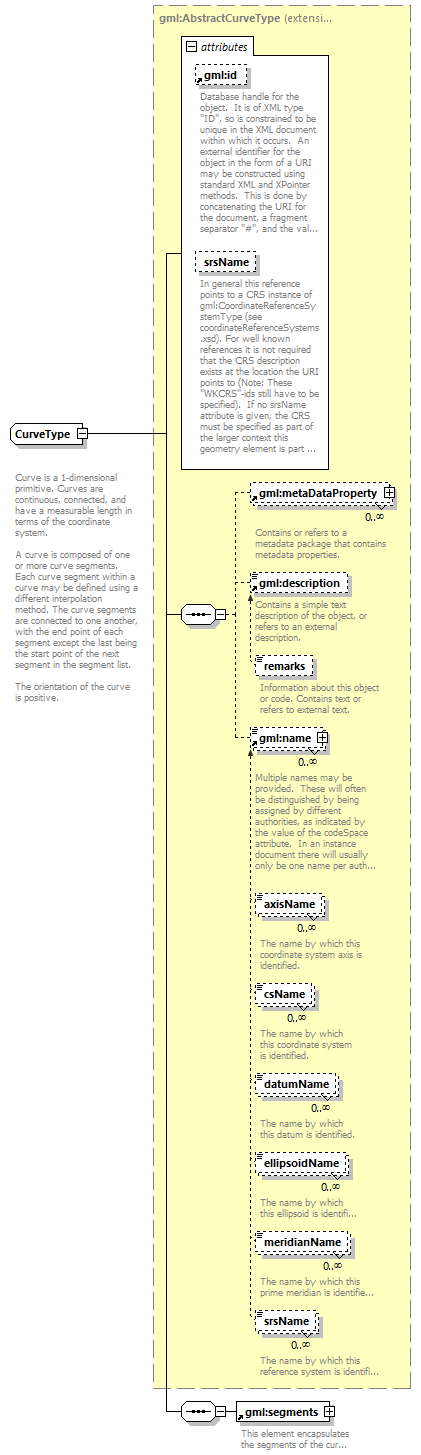 |
| namespace |
http://www.opengis.net/gml |
| type |
extension of gml:AbstractCurveType |
| properties |
| base | gml:AbstractCurveType |
|
| children |
gml:metaDataProperty gml:description gml:name gml:segments |
| used by |
|
| attributes |
| Name | Type | Use | Default | Fixed | Annotation | | gml:id | xs:ID | optional | | | | documentation | | Database handle for the object. It is of XML type "ID", so is constrained to be unique in the XML document within which it occurs. An external identifier for the object in the form of a URI may be constructed using standard XML and XPointer methods. This is done by concatenating the URI for the document, a fragment separator "#", and the value of the id attribute. |
| | srsName | xs:anyURI | optional | | | | documentation | | In general this reference points to a CRS instance of gml:CoordinateReferenceSystemType (see coordinateReferenceSystems.xsd). For well known references it is not required that the CRS description exists at the location the URI points to (Note: These "WKCRS"-ids still have to be specified). If no srsName attribute is given, the CRS must be specified as part of the larger context this geometry element is part of, e.g. a geometric aggregate. |
|
|
| annotation |
| documentation |
Curve is a 1-dimensional primitive. Curves are continuous, connected, and have a measurable length in terms of the coordinate system.
A curve is composed of one or more curve segments. Each curve segment within a curve may be defined using a different interpolation method. The curve segments are connected to one another, with the end point of each segment except the last being the start point of the next segment in the segment list.
The orientation of the curve is positive.
|
|